

STEM activities for preschoolers are a wonderful way to introduce young children to science, technology, engineering, and math through hands-on play. At this age, children are naturally curious about how things work, making STEM learning both exciting and highly effective.
Unlike traditional lessons, STEM activities encourage exploration, problem-solving, observation, and creativity. Whether children are building towers, testing floating objects, or experimenting with colors, they are developing important skills that support future learning.
Parents looking for engaging alternatives to screen time can also combine these projects with screen-free activities for kids ages 3–5 to create meaningful learning experiences throughout the day.
In this guide, you’ll discover 25 fun STEM activities that help preschoolers learn through play while building confidence, curiosity, and critical thinking skills. Many parents want to introduce STEM learning but worry they need expensive science kits or complicated experiments. The truth is that preschool STEM begins with curiosity, exploration, and simple hands-on activities using everyday household materials. These playful experiences help children build confidence while developing essential thinking and problem-solving skills.
Table of Contents
What Does STEM Really Mean for Preschoolers?
STEM stands for Science, Technology, Engineering, and Mathematics. For preschoolers, STEM isn’t about memorising facts or solving difficult equations. Instead, it’s about asking questions, experimenting, building, observing, and discovering how the world works through play.
Whether children are stacking blocks, exploring magnets, planting seeds, mixing colours, or building simple structures, they’re already developing important STEM skills that support future learning.
25 STEM Activities for Preschoolers
1. Sink or Float Experiment
This classic science activity helps children learn about different materials and how they behave in water.
Materials:
- Bowl of water
- Small household objects
Ask your child to predict whether each object will sink or float before testing it. Encourage discussion about the results and why certain objects behave differently.
Learning Benefits:
- Observation skills
- Scientific thinking
- Prediction making
2. Baking Soda Volcano
Few STEM activities for preschoolers are as exciting as creating a bubbling volcano.
Materials:
- Baking soda
- Vinegar
- Food coloring
- Small container
Mix baking soda into the container and pour vinegar over it. Watch the fizzy eruption and talk about chemical reactions in simple terms.
Learning Benefits:
- Cause and effect
- Observation
- Early science concepts
3. Magnet Exploration
Magnets introduce children to invisible forces in a fun and engaging way.
Materials:
- Child-safe magnets
- Metal and non-metal objects
Allow your child to test different items around the house and sort them into magnetic and non-magnetic groups.
Learning Benefits:
- Classification
- Investigation
- Scientific curiosity
4. Rainbow Walking Water Experiment
This colorful activity demonstrates water movement.
Materials:
- Clear cups
- Water
- Food coloring
- Paper towels
Arrange cups with colored water and connect them using paper towels. Children can observe how water travels from one cup to another.
Learning Benefits:
- Observation
- Color recognition
- Scientific inquiry
5. Building Block Tower Challenge
Challenge your child to build the tallest tower possible using blocks.
Materials:
- Building blocks
This activity encourages experimentation with balance, structure, and design.
Learning Benefits:
- Engineering thinking
- Problem-solving
- Spatial awareness
6. Ice Melting Investigation
Children love discovering how temperature affects ice.
Materials:
- Ice cubes
- Salt
- Warm water
Test different methods to see which melts ice the fastest.
Learning Benefits:
- Observation
- Comparison skills
- Scientific exploration
7. Nature Sorting Activity
Collect leaves, sticks, flowers, or rocks during a walk.
Materials:
- Natural objects
- Sorting trays
Ask children to sort items by color, size, shape, or texture.
Learning Benefits:
- Classification
- Critical thinking
- Observation
8. Shadow Exploration
Explore how shadows change throughout the day.
Materials:
- Flashlight or sunlight
- Toys or household objects
Experiment with moving objects closer and farther from the light source.
Learning Benefits:
- Understanding light
- Observation
- Scientific thinking

9. Counting and Measuring Game
Introduce simple math concepts using household items.
Materials:
- Blocks
- Measuring tape
- Cups
Count objects, compare heights, and measure simple items around the house.
Learning Benefits:
- Number recognition
- Measurement skills
- Early math concepts
10. Straw Tower Challenge
Challenge children to build structures using straws and tape.
Materials:
- Drinking straws
- Tape
Encourage experimentation with different designs and shapes.
Learning Benefits:
- Engineering skills
- Creativity
- Problem-solving
11. Color Mixing Science
Introduce primary and secondary colors through experimentation.
Materials:
- Water
- Food coloring
- Clear containers
Mix colors together and predict what new colors will appear.
Learning Benefits:
- Observation
- Creativity
- Scientific exploration
12. Water Transfer Station
Water transfer activities help children explore measurement and volume while improving coordination.
Materials:
- Cups
- Funnels
- Spoons
- Water containers
Children can pour, scoop, and transfer water between containers while experimenting with different amounts.
Learning Benefits:
- Fine motor skills
- Measurement concepts
- Problem-solving
This activity also works wonderfully alongside many indoor activities for preschoolers when outdoor play isn’t possible.
13. Balloon Rocket Experiment
This exciting activity teaches children about motion and force using simple household materials.
Materials:
- Balloon
- String
- Straw
- Tape
Thread the string through the straw and stretch it tightly. Tape an inflated balloon to the straw and release it to watch it race across the string.
Learning Benefits:
- Cause and effect
- Observation skills
- Early physics concepts
14. Shape Hunt Around the House
Turn geometry into a fun adventure by searching for shapes around your home.
Materials:
- Shape checklist
- Pencil
Ask children to find circles, squares, rectangles, and triangles in everyday objects.
Learning Benefits:
- Shape recognition
- Observation skills
- Early math learning
15. Toy Car Ramp Challenge
Children can investigate speed and motion by creating ramps at different heights.
Materials:
- Toy cars
- Cardboard
- Books
Test how changing the ramp height affects how far the car travels.
Learning Benefits:
- Engineering thinking
- Prediction skills
- Problem-solving
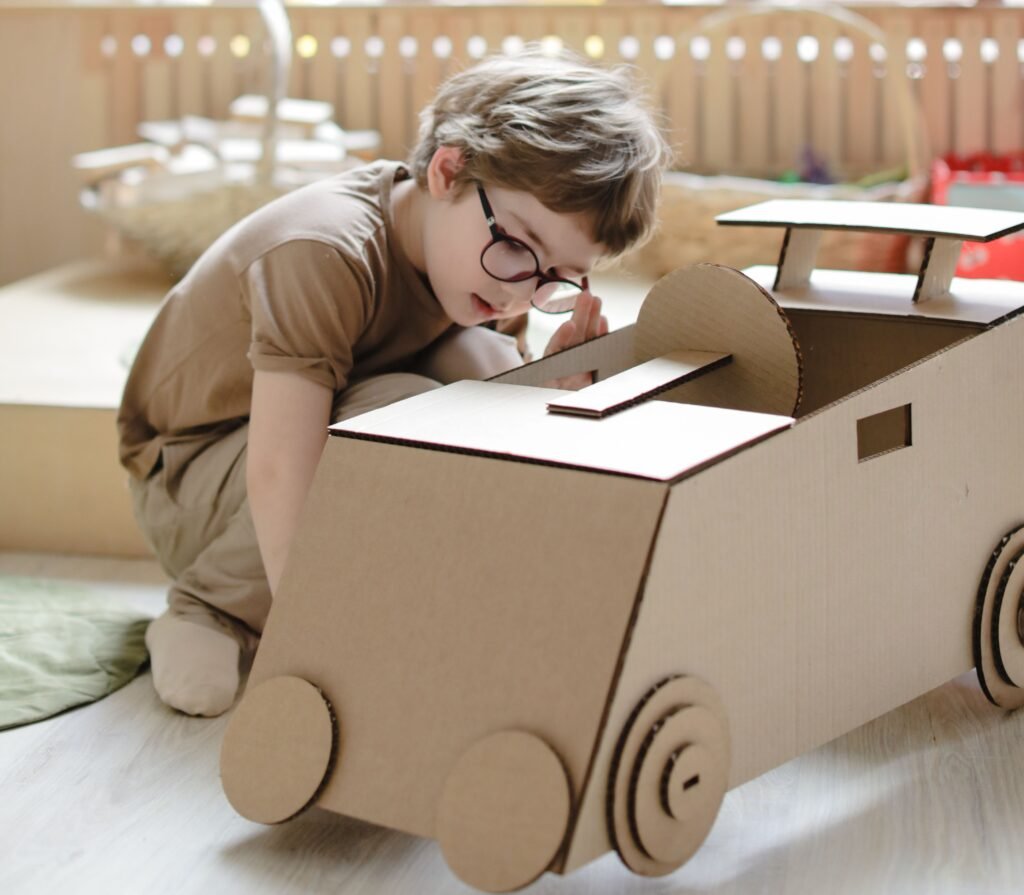
16. Magnetic Tile Engineering Challenge
Magnetic tiles are among the best educational toys for 3–5 year olds because they encourage creativity, engineering, and problem-solving through hands-on play.
Materials:
- Magnetic tiles
Challenge children to build towers, bridges, houses, or castles using different designs.
Learning Benefits:
- Engineering concepts
- Creativity
- Spatial awareness
17. Seed Growing Experiment
Growing seeds teaches patience while introducing children to plant science.
Materials:
- Bean seeds
- Paper towels
- Clear container
Observe changes each day and discuss what plants need to grow.
Learning Benefits:
- Observation
- Responsibility
- Science learning
18. Bubble Science Investigation
Children love bubbles, making this a fun STEM learning opportunity.
Materials:
- Bubble solution
- Bubble wand
Experiment with different wand sizes and observe how bubble size changes.
Learning Benefits:
- Scientific observation
- Critical thinking
- Exploration
19. Paper Airplane Testing
Create paper airplanes and compare how different designs perform.
Materials:
- Paper
Measure how far each airplane travels and discuss possible reasons for the results.
Learning Benefits:
- Engineering skills
- Testing and experimentation
- Problem-solving
20. Nature Pattern Activity
Collect leaves, rocks, flowers, or sticks and create repeating patterns.
Materials:
- Natural objects
Children can create simple or complex sequences depending on their age.
Learning Benefits:
- Pattern recognition
- Math skills
- Creativity
21. Weather Observation Chart
Introduce children to basic weather science through daily observations.
Materials:
- Weather chart
- Markers
Record sunny, cloudy, rainy, or windy days and discuss weather patterns.
Learning Benefits:
- Observation
- Data collection
- Scientific thinking
22. DIY Balance Scale
Build a simple balance scale using household materials.
Materials:
- Hanger
- Cups
- String
Compare the weight of different objects and discuss heavier versus lighter items.
Learning Benefits:
- Measurement concepts
- Critical thinking
- Math skills
23. Coding Without a Computer
Introduce basic coding concepts using movement games.
Materials:
- Direction cards
Children follow simple commands such as forward, backward, left, and right to reach a target.
Learning Benefits:
- Sequencing
- Logic
- Problem-solving
24. Building Bridge Challenge
Challenge children to design a bridge that can support small toys.
Materials:
- Blocks
- Craft sticks
- Tape
Encourage experimentation with different structures and designs.
Learning Benefits:
- Engineering thinking
- Creativity
- Testing and improving
25. Sorting and Graphing Activity
Use toys, blocks, or snacks to sort by color, shape, or size.
Materials:
- Assorted objects
Create simple graphs showing the results.
Learning Benefits:
- Classification
- Data analysis
- Early math concepts
STEM Activities by Age
Every preschooler develops at a different pace, so choosing age-appropriate STEM activities helps keep learning enjoyable and frustration-free.
Ages 3–4
At this stage, focus on simple exploration activities such as colour mixing, water play, sink-or-float experiments, sorting objects, building block towers, and nature walks. These activities encourage curiosity, observation, and early problem-solving.
Ages 4–5
Older preschoolers are ready for more structured STEM challenges like balloon rockets, magnetic experiments, simple engineering projects, measuring activities, pattern building, beginner coding games, and construction challenges.
Remember that every child learns differently. Follow your child’s interests and allow plenty of time for open-ended exploration.
Recommended STEM Toys & Learning Resources
Many of these STEM activities can be completed using everyday household items. However, if you’re looking for ready-made STEM toys and learning resources that encourage creativity, engineering, scientific exploration, and independent problem-solving, we’ve compared some of our favourite options below.
⭐ Our Top 3 Picks ⭐
🥇 Best Overall
Learning Resources Gears 100-Piece Deluxe Building Set
A fantastic introduction to engineering and cause-and-effect learning. Children build moving gear systems while strengthening problem-solving, creativity, and fine motor skills. It’s one of the best long-term STEM investments for preschoolers.
🥈 Best Science Kit
Doctor Jupiter My First Science Kit
With over 100 safe, hands-on experiments, this kit encourages young children to explore chemistry, observation, and scientific thinking in an engaging, screen-free way.
🥉 Best Creative Building Toy
PicassoTiles 60 Piece Set
Magnetic tiles inspire endless open-ended building while teaching geometry, balance, and spatial reasoning. A favorite among both parents and preschool teachers.
How STEM Activities and STEM Toys Work Together
The STEM activities for preschoolers shared in this guide help children explore science, technology, engineering, and math through hands-on play. Pairing these STEM activities with age-appropriate STEM toys can extend learning beyond individual activities, encouraging creativity, problem-solving, and critical thinking every day. Whether you’re introducing simple building challenges or fun science experiments, the right learning resources can make these activities even more engaging and enjoyable.
How STEM Learning Helps Preschoolers
Regular STEM activities do much more than teach science or maths. They encourage children to ask questions, think creatively, solve problems, communicate ideas, and develop confidence through exploration.
Most importantly, STEM helps children understand that making mistakes is a natural part of learning and discovering new solutions.
Benefits of STEM Activities for Preschoolers
STEM activities help children develop essential skills that support learning both in school and everyday life.
Cognitive Development
Science and engineering activities encourage children to ask questions, make predictions, and solve problems independently.
Many of the skills developed through STEM learning align with the CDC developmental milestones identified for preschool-aged children.
Fine Motor Development
Activities involving pouring, building, stacking, measuring, and experimenting strengthen hand muscles and coordination.
These skills support future writing, drawing, and self-care tasks.
Creativity and Imagination
Many STEM projects encourage children to test ideas and explore different solutions.
According to PBS Parents, play-based learning helps children build creativity, confidence, and independent thinking skills.
Problem-Solving Skills
Children learn that mistakes are part of the learning process and discover how to improve their designs and ideas.
Common STEM Mistakes Parents Should Avoid
STEM activities should always feel fun and exploratory rather than like classroom lessons.
Avoid these common mistakes:
✔ Giving children the answers too quickly.
✔ Expecting perfect results.
✔ Choosing activities that are too difficult.
✔ Rushing experiments.
✔ Focusing only on the final outcome.
Instead, encourage curiosity, celebrate mistakes, and ask open-ended questions that inspire children to think independently.
How to Encourage STEM Learning at Home
You don’t need expensive equipment to introduce STEM concepts.
Simple household items often work perfectly.
Try to:
- Encourage questions
- Allow experimentation
- Focus on exploration rather than perfect results
- Use everyday situations as learning opportunities
- Celebrate curiosity and creativity
Many STEM activities can also be combined with activity books for preschoolers to reinforce learning concepts through reading and hands-on practice. Some of the best STEM learning happens naturally during everyday routines. Cooking together, gardening, sorting laundry, building with blocks, fixing simple household items, and exploring nature all provide valuable opportunities for children to observe, experiment, and ask questions.
Frequently Asked Questions
What are STEM activities for preschoolers?
STEM activities for preschoolers are hands-on learning experiences that introduce science, technology, engineering, and math concepts through play. These activities encourage curiosity, creativity, and problem-solving while helping children explore how the world works.
Why are STEM activities important for preschoolers?
STEM activities help children develop critical thinking, observation, communication, and problem-solving skills. They also encourage creativity and confidence while building a strong foundation for future learning.
How do I teach STEM to a preschooler?
The best way to teach STEM is through simple play-based activities. Experiments, building challenges, sorting games, measuring activities, and nature exploration help children learn important concepts in a fun and engaging way.
What are easy STEM activities for preschoolers at home?
Easy STEM activities include sink-or-float experiments, building block challenges, color mixing experiments, balloon rockets, water transfer stations, and seed-growing projects. Most require only simple household materials.
Are STEM activities suitable for 3-year-olds?
Yes. Many STEM activities can be adapted for younger preschoolers. Focus on simple experiments, sensory exploration, and observation rather than complex explanations.
What materials do I need for preschool STEM activities?
Most activities use everyday items such as cups, water, blocks, paper, magnets, measuring tools, toy cars, balloons, and natural materials collected outdoors.
Final Thoughts
STEM activities for preschoolers provide an exciting way to introduce science, technology, engineering, and math concepts through hands-on exploration. Whether children are building towers, testing ramps, growing seeds, or experimenting with colors, these activities encourage curiosity, creativity, and confidence.
The most important goal is not to teach advanced concepts but to help children develop a love for learning. By encouraging exploration and problem-solving, parents can create meaningful learning experiences that support healthy development while making playtime both educational and fun. Remember that preschool STEM isn’t about creating future scientists overnight. It’s about encouraging curiosity, confidence, creativity, and a willingness to explore the world one question at a time. Every small experiment helps build skills that children will use throughout their lives.
We hope these STEM activities for preschoolers inspire your little learner to explore, build, experiment, and discover through everyday play. With the right mix of hands-on activities and carefully chosen STEM toys and activities can become a fun part of your child’s daily routine.
Related Preschool Learning Resources
Looking for more ways to support your preschooler’s learning and development? Explore our collection of expert guides featuring indoor and outdoor activities, educational toys, STEM projects, sensory play, fine and gross motor activities, kindergarten readiness tips, screen-free ideas, and the best activity books for preschoolers. These practical resources are designed to make learning fun, engaging, and meaningful every day.
- Best Activity Books for Preschoolers
- Indoor Activities for Preschoolers on Rainy Days
- Best Educational Toys for 3–5 Year Olds
- Screen-Free Activities for Kids Ages 3–5
- Fine Motor Activities for Preschoolers
- Gross Motor Activities for Preschoolers
- Kindergarten Readiness Activities
- Sensory Activities for Preschoolers
- Outdoor Activities for Preschoolers
Pingback: Best Activity Books for Preschoolers: 15 Fun Learning Picks for Ages 3–5
Pingback: Screen Free Activities for Kids: 25 Fun Ideas for Ages 3–5